Wednesday, January 4, 2012

Here's to 2012!

Every New Year we like to reminisce about events from the previous year. So I thought, for my first post of the year 2012, I shall quickly jot down some notable good eats from the year 2011 (as much as my little brain can recollect), starting with the most recent one:

1. The chorizo tacos, chicken fajitas, Camarones a la Diabla and chips and salsa at Taqueria La Venedita in Issaquah. Unfortunately I do not have any pictures.

2. The Currywurst at Leavenworth.

Currywurst with jalapenos, hot jalapeno mustard and sauerkraut
3. Fish Molee at Sadya Palace. Again, no pictures.

4. Pizza made by our dear daughter- she made it from scratch! In fact, I must post her recipe one of these days. She made it for our wedding anniversary. It was truly superb!

Nani's Pizza!
5. Mongolian "Beef" and veggies made by my brother.

Hot and spicy Mongolian "Beef" & Veggies
6. Chantarelle stir-fry made by my brother.

Buttery Chantarelle
7. Of course the Benne Masala Dosa at CTR and the gobi manchuri at RSI that I had when I visited my folks in September. No pictures again! 

I am sure there were plenty other good eats in 2011, and I sure am not going to try and remember every single one of them. But overall, 2011 was good and here's wishing everybody a Very Healthy and Happy 2012!

P.S.: Don't make too many of those resolutions....... I know I am not! ;)

Friday, December 16, 2011

A Small Achievement!

I am so excited! My article got selected for publication in the Winter 2011, Volume 16, Number 3 edition of  "Education About Asia," and is out now! Well, this is only for the online version, but, for a first timer, this is pretty big! I wrote on FOOD- of course; specifically on Poha and its relation to Krishna.

Here goes my Vote of Thanks: 

  • I owe it first of all, to my brother, for giving me that much-needed push. Thanks, bro!
  • Next, I owe it to all those umpteen Amar Chitra Katha comics that I read back as a kid, that means- thanks to my folks for spending all their hard earned money on those comics- totally worthwhile, I must say! 
  • And of course, I owe it to EAA for accepting my article and putting it up in their Winter edition!!
Now, if you are interested, please do go check it out at:
http://www.asian-studies.org/EAA/Archives-06-11.htm

Click on the very first one on the right under Volume 16 (2011) and you should see it listed under the "Online Supplement." 


Wednesday, December 7, 2011

Paani Poori- SLURRRRP!

Paani Poori is an extremely popular street-food in India. Paani means water and poori is basically fried, puffed up Indian flat bread. Uh, yeah, flat bread that is puffed up! In this case, the poori is nice and thin and crunchy. And oh, bite sized and made with (correct me if I am wrong) a combination of semolina flour and all purpose flour. Another name for paani-poori is golgappa; plural: golgappe or golgappas.

The main idea behind this snack is to poke a hole in the tiny little poori and dunk the poori in this very tangy, spicy, tamarind water so that the poori is filled with that water (paani) and keep popping one poori after another into your mouth, until you are full; rather, until you are satisfied, which could actually take a while, just so you know.

Here's how you do it: You put one poori filled with the paani into your mouth, close your mouth and gently pop the poori with the help of your tongue onto your palate. What follows is this really "loud" explosion inside your mouth, with all that delicious spicy tangy water gushing into your taste buds and you literally shudder and close your eyes in ecstasy, followed by some major lip-smacking (remember, this is street-food we're talking about!). You do the same with the next poori and the next......and yeah, you got it- the cycle continues! 

Now along with the paani, you can add certain other fillings such as cooked garbanzo, potato, mint chutney and perhaps finely chopped onion, green chilies, cilantro etc.

And here is my take on paani poori and believe me, you'll see that it is extremely EASY!

Ingredients:

1. I buy the (paani) poori package from the Indian store. That just made the whole thing easy, didn't it? (Oh, by the way, don't worry about the spelling....... poori or puri--- doesn't matter, sort of like tomAAto Vs toMAYto.......)

Paani Poori (or Pani Puri) box from the Indian store
2. Cooked garbanzo beans- easiest way is to open a can of garbanzo, all ready to use!

3. Tamarind concentrate (available in any Indian or Asian store).

4. Mint leaves, a couple green chilies, a clove of garlic and some lemon juice for mint chutney.

5. Potatoes- cooked (pressure cooker works best for this or the m-wave may be used) and chopped.

6. Salt, Red chili powder/cayenne pepper, black pepper powder, cumin powder, pinch of garam masala powder (optional), pinch or more of sugar (depends on individual taste preference), pinch of aamchur (dry mango powder)- optional.

Note: The spices are really your choice.

Steps:

1. Open a can of garbanzo beans. I like to wash them in running water to "freshen" them up a bit. I add a pinch of salt, cumin powder, garam masala powder and just mix it all up.

Chickpeas/Garbanzo
2. Next, I get the potato ready. If it is just the four of us, then I just take 1 medium potato, wash it, poke it a bit with a fork all over and then cook it in the microwave. Takes about 3 to 5 minutes. I then peel it, chop it up and season with salt and perhaps some garam masala powder or even just plain simple ground black pepper.

Potato
3. For the paani (the spicy tangy tamarind water), I take a teaspoon of the tamarind concentrate, dilute it with 1/2 a cup of warm water (makes it easier to thin out the concentrate) and then add salt, cumin powder, red chili powder and a pinch of sugar. If you like it sweeter, then add more sugar. And then I stir it all up, and add some more water (room temperature) to thin it out completely. There, the paani is ready! (Of course, I do taste it and adjust accordingly).

Paani- Spicy Tamarind water
4. For the mint chutney, I pluck leaves from my very own home-grown mint plant (how much more organic can you get?!) and then wash the leaves and make a quick not-too-thick chutney in my food processor. It is very simple, really: mint leaves+a clove of garlic+1-2 green chilies+a dash of lemon juice+salt+1/4 cup of water. One or two pulses in the food processor and voila, mint chutney is ready.

My mint plant (as proof!)
Mm-Mint Chutney!
5. And, last but not the least, I open that box of (paani) pooris to get the party going!

Pooris!
Like I explained earlier, you poke a hole in a poori, stuff it with some garbanzo, potato and mint chutney and then dunk it in or spoon in some of that lip-smacking delicious tamarind water into the hole and pop it into your mouth and just keep eating........

Paani Pooris- SLURRRP!

Sometimes, we eat paani pooris for dinner. Yes! I just pick up a couple boxes of pooris from the Indian store and it works out great. The kids love it too! Light, satisfying and totally slurpilicious!

P.S.: Thanks to the lack of sunshine and the cold temperature at this time of the year, my mint plant is not doing very well, though I am trying to keep it alive and kicking........ gotta see how that goes!


Tuesday, November 22, 2011

Kashmiri Eggplant- Marzwangan Kurma, from the story, "Mazzoo Mazzoo"

Have you ever cooked up a delicious dish taking inspiration from a children's story book? I have!

A few years ago, my kids' grandmother gave them a little story book- a Kashmiri folk tale titled, "Mazzoo Mazzoo," by Sandhya Rao. The entire story is about 10 pages long. Perfect read for a little kid and even for little kids' mommies! The story revolves around a very famous Kashmiri dish called Marzwangan Kurma and in fact, has this lovely little poem, that I assume is written by the author or perhaps translated from Kashmiri into English by the author. Funnily, this little poem is actually the recipe for this beautiful dish! Here, take a look at the poem below:

Recipe for Marzwangan Kurma
And so, the other day I suddenly remembered the story and the dish in particular (of course) and I just had to make it. I went to the store specifically to buy eggplant (brinjal) and meanwhile, the previous night, I soaked a handful of almonds so that it would be easy for me to peel them the next day. I had ginger and cardamom and of course, turmeric powder, tamarind paste and salt. I did not have Kashmiri red chillies (famous for their deep color and mild flavor) and therefore swapped those for some normal red chillies that I had bought at the Indian store. I did not have cinnamon either and so decided to just make-do without it.

I literally followed the poem. Here are the pictures which are pretty self-explanatory:

Almonds, cardamom, ginger, eggplant, tamarind paste
& red chillies too. Eggplant sliced and ginger chopped.
Red chillies & Cardamom ground together in my nifty little grinder
Almond & Ginger Paste (using my food processor)

Note about the almond and ginger paste: I added just a tad bit of water to allow for a paste. When the paste was ready and I opened the lid, I was hit by this astoundingly divine aroma and upon tasting it, I thought to myself that this itself is super delicious and maybe if I add some sugar to this, it will turn into a beautiful dessert! I mean, it was just that yummy!! (Of course, one has got to love ginger to love this almond-ginger paste).

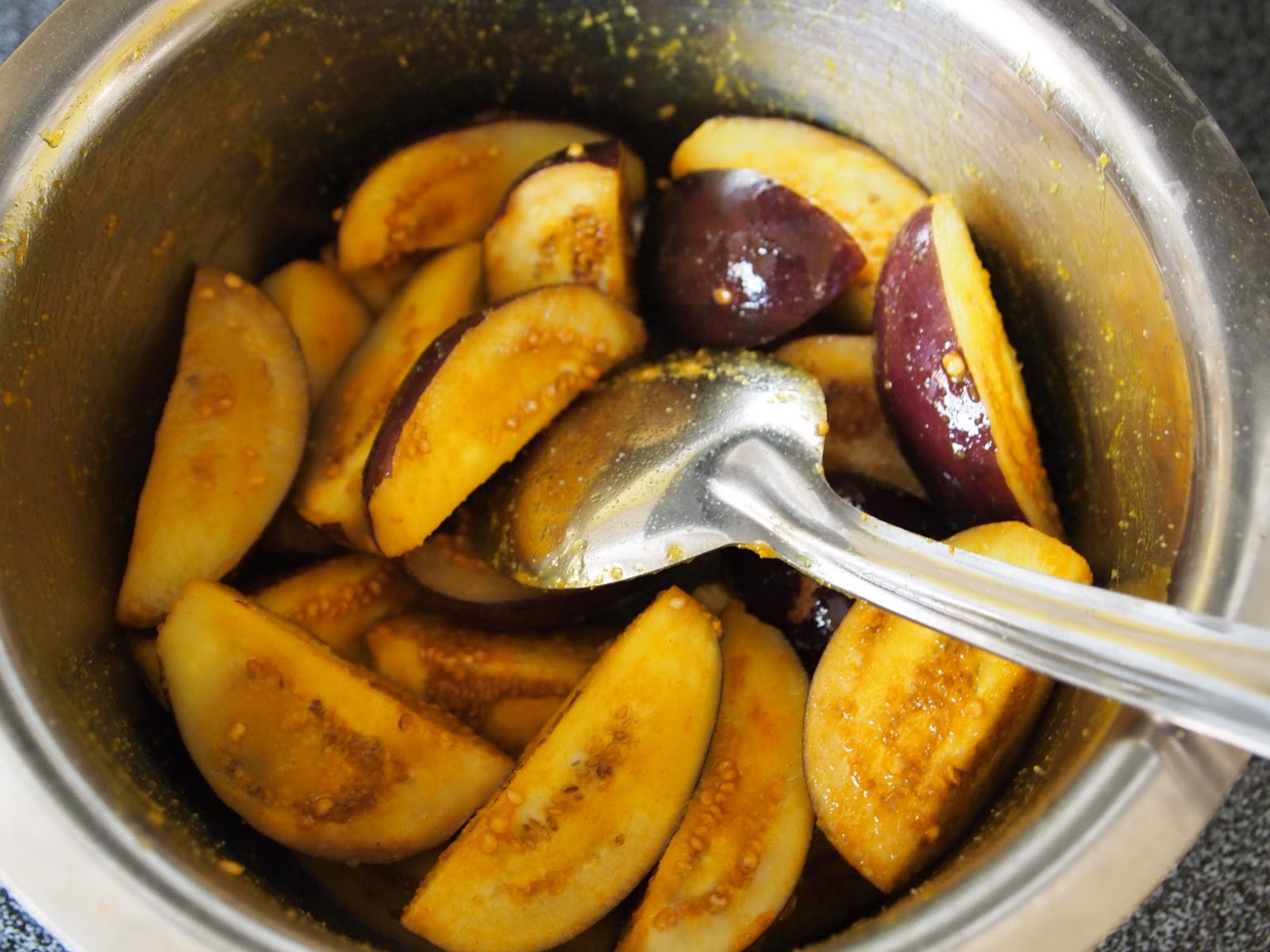
Eggplant tossed with turmeric and salt, being fried in some oil.
In goes the almond ginger paste & the red chillies+cardamom powder
& tamarind plus some water, just enough to barely cover the eggplant
Simmering away for 15 minutes-- divine aroma, BTW!
Marzwangan Kurma ready (the gravy is thickened).

In less than 20 minutes, I had made Marzwangan Kurma, from a Kashmiri folk tale! I sure felt mighty pleased with myself and the dish- it tasted beautiful. The eggplant was nice and juicy and tasted delicious in the gravy that was tangy from the tamarind, and had this flowery aroma from the cardamom, while the red chillies added some heat. I did not miss the cinnamon, but I bet that would add to the overall flavor of the dish. And you can never go wrong with almonds! I served the kurma with rotis.

Funny how I followed that book to make a dish, huh? Well, hey, one can derive inspiration from anywhere, anything- even a simple little children's story!


Monday, November 14, 2011

Title change

My brother, my only active reader (haha!), suggested a title for my previous post where I explained how I made paneer. And I love it- "When life gives you sour milk, make paneer!" How apt! Thanks, bro!

Sunday, November 13, 2011

Paneer Scramble!

Remember that paneer I made a couple days ago? Well, for lunch today, I made paneer ki bhurji or paneer scramble from that same paneer that I made. It is quite similar to tofu scramble and in fact is pretty much like scrambled eggs, except all jazzed up with onions, tomatoes, green chilies and some spices. (http://yetanotherfoodie.blogspot.com/2011/01/masala-bhurji.html)

If you go take a look at the above link for "Masala Bhurji," this paneer ki bhurji is the same. Extremely quick and easy and delicious!
  • I chopped up a medium size onion, a couple tomatoes and 3-4 green chilies. 
  • Fried this in a little bit of oil and mustard seeds (cumin seeds work too) and then added the home made paneer, followed by salt, turmeric powder, some red chili powder and just a pinch of garam masala.
  • I crumbled up the paneer in the pan itself with the spatula. While doing so, I delighted in the fact that the home-made paneer was of excellent quality- oh yeah! I gave everything one last stir and then covered the lid. Simmered for about 5 minutes and turned off the stove.
  • And that's it-- paneer ki bhurji or paneer scramble was ready. Before serving, I garnished with some fresh cilantro.

Simple ingredients
Paneer Scramble
Ready to eat!
*One could add green peas to this dish too for color.

Our Sunday lunch comprised of rotis with paneer ki bhurji, followed by a glass of buttermilk. Simple, delicious and satisfying!

Friday, November 11, 2011

I made Paneer (Indian Cottage Cheese)! Thanks, Priya!

We consume a lot of dairy in our household. In fact, my shopping cart almost always has 2 gallons of 2% reduced fat milk (for the kids), 1 gallon of plain soy milk (for us) and at least 1 gallon of buttermilk, with the occasional pint of low fat yogurt thrown in. Oh and everything is organic [They really should have come up with a different term. I mean, isn't all food organic anyways?!]. And this lasts us for about 10 days.

Quick note on the soy milk--- the husband switched to soy milk a few years ago because he claimed that regular milk made him feel all bloated. And soy milk seemed to work fine. So then he introduced it to me and at first, I hated it. But then, slowly, as with anything else, I got used to it and now I prefer my chai and coffee with soy milk.

A few days ago I did my usual dairy shopping. The next morning, my kids complained that the milk tasted bad. I smelled it and yes indeed, it smelled funny. The first thought that came to my head was, "Great! Now I have to go back to the darn store to return it!" After going back and forth on whether or not it made sense to drive all the way back to the store and waste time (and gasoline!), I decided to pick up some milk from my back-up store--- you know, our neighborhood store. Meanwhile, for some reason, I put that "weird" smelling milk back in the fridge. Well, guess that worked out, because I made paneer with that milk yesterday and really, I am so proud of myself!

Paneer is basically cottage cheese, except that it is firm, not loose like cottage cheese. Very popular in North Indian cuisine--- am sure you are familiar with dishes such as Saag Paneer, Matar Paneer and Paneer Butter Masala! Yum!

Now many of you might be already adept at making paneer at home and so this might be a no-brainer to you. But to me, it is quite a deal. This is probably only the second time in my life so far that I have made paneer at home! So yes, it is a big deal for me!

I took: 

1. That gallon of "funny" milk
2. A cup and quarter of vinegar (I used rice vinegar)

The Method:

1. I poured in all that milk into a fairly thick bottomed pot (which happens to be my cooker) and got the heat going. I kept it on low first and then after about 10 minutes, when the milk was beginning to warm up, I increased the flame. This was to prevent any kind of scorching-at-the-bottom-issue.

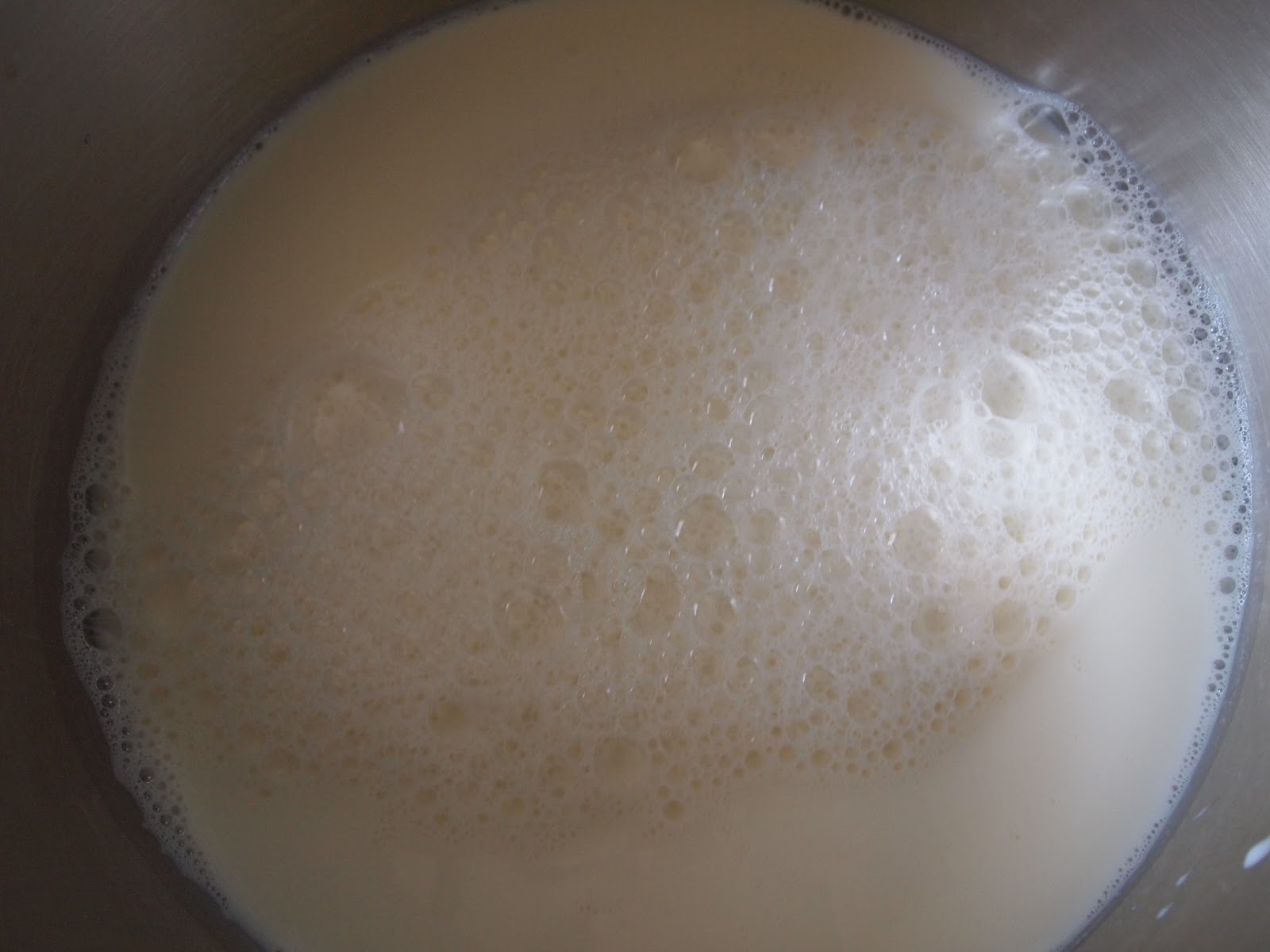
"Funny" Milk
2. Soon (this depends on where you live, how intense your stove is, what kind of a pot you use etc) the milk came to a little boil. At this point, I added a tablespoon of vinegar to the milk and immediately, the milk started coagulating.

Coagulation
However, something wasn't right. I remembered how my mom used to make paneer back when we were kids...... and I knew that this wasn't looking quite right. And so I picked up the phone and called my very dear friend, Priya, since she is an expert at paneer-making. She said that I need to add at least a cup of vinegar and that will lead to complete coagulation, leaving a greenish liquid behind. Aha! Thanks, Priya!

3. And so I added a cup of vinegar, bit by bit, while stirring the milk, until there was some major coagulation action going on and I began to see this translucent greenish colored liquid. I was so excited! That was cottage cheese right there, separating from the whey!

Now we're talking- cottage cheese in the making!
4. I needed a muslin cloth to collect the cottage cheese. But since I didn't have any muslin cloth at  home (err, I still don't!), I took this fairly thin wash cloth (made sure it wasn't smelling like laundry detergent!) and poured in the contents from the cooker, so as to drain off the greenish liquid, aka, whey, while retaining the cottage cheese in the cloth.

My substitute for muslin cloth
Fresh Cottage Cheese!
P.S.: I collected the whey in a bowl so I could take a picture and show it to you, if you too happen to be a novice at paneer-making like me. In the picture it looks more yellowish than greenish because of the lights in my kitchen and I forgot to turn on the flash in my camera!

The Whey
5. And then I tied up the cloth, so as to drain any remaining liquid from the cheese. The key to good paneer is to have it nice and firm and devoid of any whey.

Draining off excess liquid
6. I then took this heavy iron tortilla maker and pressed the cheese (that I placed on a plate) with it--- so as to flatten it a bit and of course, drain off every bit of liquid from it. 

Pressing the cheese

Top View
7. I left this on the counter top to set and after 5 hours or so, I checked it. I was overjoyed to see paneer!! Yes, real paneer! I took a little piece off and tasted it and it tasted so good!!

Paneer!!!!
8. I then wrapped it up with some plastic wrap and put it away in the fridge. 

Home Made Paneer!
And this is how, ladies and gentlemen, I made paneer at home from that "funny" milk. Would I do this again? Umm, only if there's weird tasting milk at home. I mean, though this is great, since it is home made, it does take quite a bit of time, effort, and cleaning up, especially the scrubbing you have to do to clean the pot in the end! So I think I'll stick to buying my paneer from the store.

Note: Not sure what to label this post as....... any suggestions?